A commercial dual-angle Smith machine is a guided barbell system designed for demanding gym environments. It usually offers two bar paths, such as vertical and angled movement, within one frame. This design can support squats, presses, lunges, and controlled pulling exercises. The bar travels along fixed rails, helping users manage balance while focusing on force production and technique.
Commercial Dual-Angle Smith Machines are built for frequent use. A strong frame, smooth bearings, adjustable safety catches, and clearly marked rack positions are important details. In a busy facility, the bar should move quietly and remain stable under repeated loading. I have found that small details matter. A poorly placed hook can interrupt a set, while a sharp catch adjustment can slow down beginners. The machine should also provide enough clearance for different body sizes and lifting styles.
The dual-angle concept sounds straightforward, but product designs can differ considerably. Some machines use separate rails, while others combine paths within one structure. An angled path may feel natural during pressing, yet it will not suit every lifter or exercise. Personal coaching experience and manufacturer specifications should guide the choice. I would not judge a machine by its polished frame alone. Test the starting height, rail smoothness, handle position, and safety settings before purchase. A reliable model balances biomechanics, durability, user access, and maintenance requirements. That balance is often harder to achieve than advertisements suggest.
What Is a Commercial Dual Angle Smith Machine?
Definition and Core Function of a Commercial Dual Angle Smith Machine
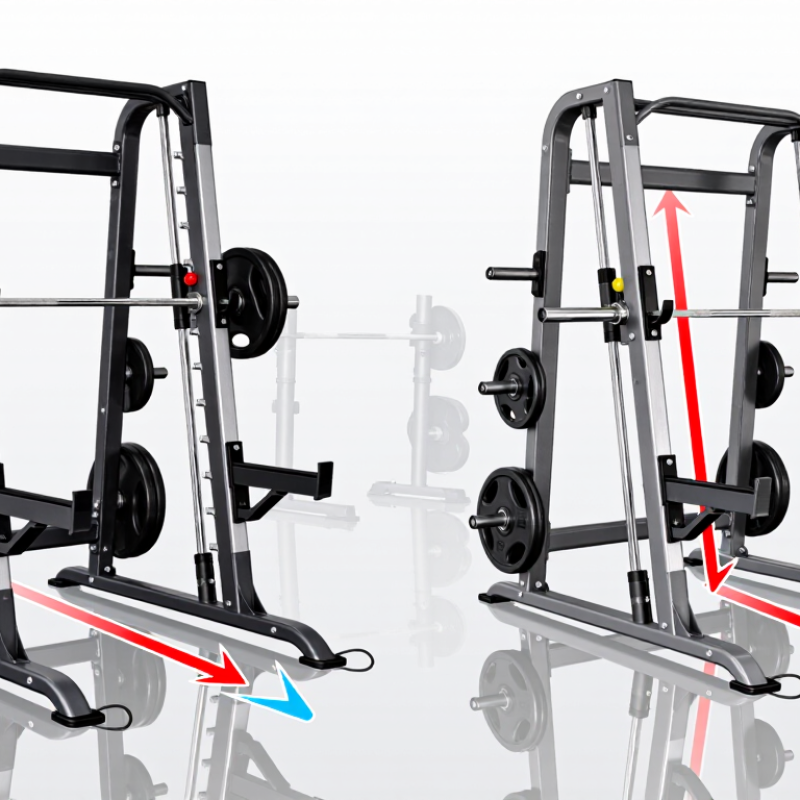
A commercial dual angle Smith machine is a guided barbell system with two available movement paths. One path is usually vertical, while the other follows a controlled incline. Exact angles vary by construction. The frame commonly includes linear bearings, adjustable safety catches, counterbalance assistance, and a reinforced steel structure for frequent facility use. Its core function is simple: it supports loaded training while limiting unwanted bar movement.
A vertical path can suit squats, presses, and calf raises. An angled path may follow the user’s natural shoulder or hip mechanics more comfortably. The bar moves along fixed rails, so beginners can train without balancing a free bar. Experienced users also gain faster setup between sessions. ACSM’s 2024 Worldwide Survey ranked traditional strength training fifth among global fitness trends, based on responses from more than 1,900 professionals. That demand makes guided strength equipment relevant in commercial gyms.
EuropeActive and Deloitte reported approximately 71.6 million fitness club members across Europe in 2023. High-use equipment therefore needs durable hardware and clear adjustment points. A dual-angle design can serve different body sizes and exercise preferences, but it is not automatically safer. Poor rack height, limited range of motion, or excessive loading still creates problems. It can feel secure.
In practice, coaches should inspect rail smoothness, locking positions, cable condition, and user clearance. The machine’s convenience may also reduce stabilizer-muscle demands compared with free-weight training. That trade-off deserves attention. Data supports strength-training demand, but each facility should test usability, maintenance access, and member technique before purchase.
A commercial dual-angle Smith machine is a guided barbell system that supports both vertical and angled bar paths. The fixed path improves control, while the selected angle can change the direction of resistance during exercises such as squats, presses, and lunges.
Core function: As the rail angle increases from vertical, a larger component of the bar's weight acts along the rail. The values shown are calculated from the sine of each angle and represent the theoretical gravity component as a percentage of bar weight.
A commercial dual angle Smith machine is a guided resistance station built for busy gyms. Its key feature is a barbell that follows two movement angles instead of one fixed vertical path. Depending on the design, the rails may combine vertical travel with a slight forward or backward incline. This can better match natural pressing and squatting mechanics. It also changes how the load feels through the hips, knees, shoulders, and chest.
The main components include angled guide rails, linear bearings, safety catches, a counterbalanced bar, adjustable hooks, and a reinforced frame. Dual-angle movement requires precise rail alignment. Small inconsistencies can create unwanted friction. That detail is easy to overlook. The bar should move smoothly at the top, middle, and bottom of each repetition. Users should test the path with an unloaded bar before adding plates.
Demand for strength equipment remains substantial. The Health & Fitness Association reported 72.9 million U.S. fitness-facility users in 2023. ACSM’s 2025 Worldwide Survey ranked traditional strength training fifth among global fitness trends. These figures support the role of guided strength stations in commercial facilities. However, “dual angle” is not a universal engineering standard. Buyers should inspect the actual rail angle, bar travel, safety spacing, and maintenance access. A machine may feel impressive, yet still limit certain body proportions or exercises. Hands-on testing matters more than a product sheet.
A commercial dual angle Smith machine guides the bar along two coordinated planes rather than a single vertical rail. This design can let the bar move upward while shifting slightly forward or backward. That movement may feel closer to a natural squat, press, or lunge path. The exact angle depends on the machine’s frame, so users should inspect the rails before loading weight.
The bar usually runs through bearings, with adjustable hooks and safety stops positioned along the columns. These stops can catch the bar when fatigue changes technique. In practical use, I set the empty bar first, then test the lowest safety position with slow repetitions. A poor setting can still restrict movement.
ACSM’s 2024 Worldwide Survey ranked traditional strength training fifth among major fitness trends. This supports the growing demand for structured resistance equipment. The World Health Organization also recommends muscle-strengthening activities on at least two days weekly. A dual angle system may help users train with controlled resistance while maintaining a guided path. However, guided motion is not automatically better. Some lifters may find the angle comfortable, while others may notice unusual knee, shoulder, or wrist pressure. That difference matters.
Commercial construction often includes reinforced steel, sealed bearings, and high-capacity weight storage. Yet durability depends on maintenance, alignment, and repeated inspection. A machine can look solid and still develop rail friction. That detail is easy to miss. Trainers should record user height, stance, bar position, and load when evaluating performance. This creates more reliable decisions than judging the machine by appearance alone.
A commercial dual angle Smith machine uses two slightly angled guide rails to control bar movement. The angle may better follow natural pressing or squatting mechanics, but it is not automatically safer. A 2024 ACSM Worldwide Survey ranked traditional strength training fifth among global fitness trends. That demand makes dependable equipment design increasingly important in busy facilities.
Safety depends on details users can see and test. Look for adjustable safety catches, secure locking hooks, stable feet, and clear load ratings. The bar should travel smoothly without side-to-side play. A simple empty-bar test matters. It can reveal rough bearings or uneven rails. ASTM F2276 provides safety and performance guidance for fitness equipment, but operators still need scheduled inspections. Cables, bolts, welds, and stop positions require records, not assumptions.
Adjustability should fit different bodies and exercises. Check the starting height, catch spacing, bench clearance, and rail angle. A shorter user may need lower settings for controlled squats. Taller users may need more headroom during overhead work. IHRSA’s 2023 Global Report recorded 72.9 million U.S. fitness-facility memberships in 2022, highlighting the need for equipment that serves varied users repeatedly. Coaches should explain escape routes and never treat the Smith bar as a replacement for judgment. The guided path can reduce balance demands, yet it may also hide poor technique. That trade-off deserves honest discussion.
What Is a Commercial Dual Angle Smith Machine?
Commercial Applications, Benefits, and Maintenance Requirements
A commercial dual angle Smith machine combines two guided bar paths in one training station. Its angled rails support pressing, squatting, lunging, and controlled return-to-training exercises. Commercial gyms use it where floor space, member demand, and equipment variety matter. Two users can train together. The design also helps coaches demonstrate consistent movement paths to beginners. However, angled travel is not automatically suitable for every body shape. A trial session remains essential.
For busy facilities, the machine offers predictable spotting support and adjustable safety catches. That can reduce setup time during peak hours. It also supports progressive loading when users record rack height, repetitions, and resistance. Coaches may program split squats, incline presses, or single-leg work without moving across the gym. The second angle can change joint demands, but it does not replace sound technique. Staff should watch knee tracking, shoulder comfort, and bar alignment. Small fit errors become repeated problems.
Maintenance should follow a written inspection log. Before opening, staff can check bolts, guide rods, catches, cables, and floor anchors. Wipe contact surfaces after busy periods, then clean and lubricate moving parts according to the equipment manual. Do not over-lubricate. It can attract abrasive dust. Monthly inspections should examine unusual noise, uneven travel, worn bushings, and loose hardware. A qualified technician should assess structural damage or persistent resistance. One practical weakness is often overlooked: rushed cleaning may hide early wear. Clear records make repairs easier to verify and safer to schedule.
| Data Dimension | Typical Commercial Specification or Guidance | Practical Application |
|---|---|---|
| Definition | A dual-angle Smith machine is a guided barbell system with two bar paths or frame angles, commonly combining vertical and slightly inclined movement patterns. | Allows a facility to support standard Smith-machine exercises while offering an additional movement angle for different body positions and training goals. |
| Primary Users | Commercial gyms, health clubs, sports-performance centers, hotel fitness rooms, universities, and physical-training facilities. | Suitable for beginners who need a guided bar path and experienced users who want controlled compound training. |
| Typical Frame Material | Welded structural steel, often using tubing approximately 50–100 mm in width, with a powder-coated or equivalent durable finish. | Provides rigidity, impact resistance, and better durability under frequent daily use. |
| Barbell Capacity | Commercial models commonly support approximately 200–350 kg of rated bar and user load, but the exact limit must be confirmed from the equipment specification plate. | Provides sufficient capacity for squats, presses, lunges, rows, and other loaded movements in most general fitness environments. |
| Bar Travel | Usually about 1.8–2.4 m of usable vertical travel, depending on the frame design and safety-stop arrangement. | Accommodates common squat, bench-press, shoulder-press, and split-squat ranges of motion. |
| Guide-Rod or Bearing System | Chrome-plated guide rods with linear bearings, bushings, or a comparable guided carriage system. | Maintains a predictable bar path and reduces the need for balance compared with a free barbell. |
| Angle Configuration | One bar path may be vertical, while the second is commonly inclined by approximately 5–15 degrees. Actual geometry varies by model. | Offers different loading directions and may provide a more suitable setup for pressing, squatting, or athletic training variations. |
| Safety Stops | Adjustable safety catches or stop pins should be positioned below the user's lowest intended range of motion. | Limits downward travel and reduces the risk of bar entrapment during failed repetitions. |
| Locking Mechanism | Rotating hooks, locking pegs, or similar mechanisms should engage securely at multiple rack positions. | Enables users to rack the bar quickly from different starting heights. |
| Common Exercises | Back squats, front squats, split squats, lunges, bench presses, incline presses, overhead presses, bent-over rows, and calf raises. | Supports full-body programming with one space-efficient strength station. |
| Commercial Space Requirement | A typical unit may occupy approximately 2.0–3.0 m in length, 1.5–2.2 m in width, and 2.1–2.5 m in height. Add clearance for plates, benches, and user movement. | Facilities should measure the complete training footprint rather than only the machine frame. |
| Floor Requirements | A level, structurally sound floor with suitable rubber or impact-absorbing flooring is recommended. Anchoring may be required for some designs. | Improves stability, protects the floor, and reduces vibration and noise. |
| Main Commercial Benefits | Guided movement, multiple exercise options, adjustable safety features, high user throughput, and relatively efficient use of floor space. | Helps operators serve different ability levels while supporting organized strength-training zones. |
| Operational Limitation | The fixed bar path does not reproduce the natural stabilization demands of a free-weight barbell, and the selected angle may not suit every user. | Facilities should provide free weights and alternative machines for balanced programming. |
| Daily Inspection | Check guide-rod smoothness, locking hooks, safety stops, frame stability, fasteners, padding, and visible damage before opening. | Remove the unit from service if a safety component is loose, cracked, bent, or unable to lock correctly. |
| Cleaning Frequency | Wipe contact surfaces and handles daily or after heavy-use periods with a compatible, non-abrasive cleaner. Avoid spraying directly into bearings. | Reduces sweat-related corrosion, surface contamination, and premature upholstery wear. |
| Lubrication Interval | Inspect monthly and lubricate guide rods or approved moving points according to the maintenance manual; high-use facilities may require more frequent servicing. | Maintains smooth travel and helps prevent excess wear, binding, and abnormal noise. |
| Fastener Inspection | Inspect bolts, nuts, frame joints, rack components, and anchoring points monthly or more often under intensive use. | Prevents instability, rattling, misalignment, and progressive structural damage. |
| Professional Service | A documented full inspection is commonly scheduled every 6–12 months, with immediate service after impact, abnormal noise, or a failed safety check. | Supports preventive maintenance, equipment records, and safer long-term operation. |
| Recommended User Guidance | Display instructions for setting the bar height, engaging the locking mechanism, positioning safety stops, and selecting an appropriate load. | Improves user confidence and reduces preventable misuse in busy facilities. |
| Procurement Checklist | Verify rated load, dimensions, ceiling height, bar-path angles, safety-stop adjustment, warranty terms, replacement-part availability, installation requirements, and maintenance documentation. | Ensures that the equipment fits the facility, operating budget, user population, and service capabilities. |
It is a guided barbell station with two movement angles. The bar may travel vertically and slightly forward or backward. It is not a universal design standard.
Key parts include angled rails, linear bearings, safety catches, adjustable hooks, and a reinforced frame. A counterbalanced bar can make setup easier. Rail alignment matters greatly.
Move the unloaded bar through the top, middle, and bottom positions. Watch for scraping, hesitation, or uneven resistance. Test it slowly.
Common options include squats, presses, lunges, split squats, and single-leg exercises. Coaches can adjust the bar height for different users. Some body proportions may still feel uncomfortable.
No. It may change pressure around the hips, knees, shoulders, and chest. Good technique remains necessary. The machine is helpful, not magical.
Guided travel offers predictable support during crowded training periods. Adjustable catches can reduce setup time. Two people may train nearby, but supervision remains important.
Check bolts, guide rods, catches, cables, and floor anchors. Look for loose hardware or unusual movement. Small faults can become repeated problems.
Wipe contact surfaces after busy periods. Lubricate moving parts according to the manual, but do not over-lubricate. Excess lubricant can trap abrasive dust.
A smooth product sheet may hide poor fit or difficult maintenance access. Rushed cleaning can conceal early wear. Hands-on testing is still better.
A Commercial Dual-Angle Smith Machine is a commercial-grade strength-training system that guides a barbell along an angled path while supporting controlled resistance exercises. Its dual-angle movement design allows the bar to travel through different lifting directions, helping users train the chest, shoulders, legs, back, and other major muscle groups with greater positioning flexibility. Key components typically include a guided bar, adjustable safety catches, weight sleeves, a sturdy frame, and multiple racking positions.
Commercial Dual-Angle Smith Machines are designed to combine stability, adjustability, and user control. Safety stops and enclosed bar guidance can help reduce the risk of losing control, while adjustable settings accommodate users with different heights, training levels, and exercise preferences. They are suitable for gyms, training centers, schools, hotels, and other high-use facilities. Regular maintenance should include inspecting bolts, guide rails, hooks, cables, and safety mechanisms, as well as cleaning and lubricating moving parts according to the equipment’s care requirements.